
PSA, CGC, or PCA: which grading service should you choose for your Pokémon cards? (2026 Guide)
Are you hesitating between PSA, CGC, and PCA for grading your Pokémon cards? This guide compares the three grading services most used by French-speaking collectors: pricing, turnaround times, grading criteria, resale value… and how to prepare your cards to aim for the best possible grade.
What exactly is grading?
Grading consists of having a card authenticated and evaluated by an independent organization. The card is examined (centering, corners, edges, surface), given a grade out of 10, and then sealed in a rigid case called a slab. A card graded 9 or 10 can see its value multiplied by 2 to 10 times compared to the same card ungraded.
PSA: the global benchmark
PSA (Professional Sports Authenticator) is the historic American leader. Its strengths:
- The highest resale recognition: a PSA 10 almost always sells for more than a 10 from another grader;
- A publicly viewable population report;
- Ideal for high-value cards (vintage, rare Japanese cards, full arts).
Drawbacks: sometimes long turnaround times from Europe and shipping costs to the United States (or using a European intermediary).
CGC: the best value for money
CGC Cards offers a reputation for strict grading, very readable slabs, and prices that are often more affordable than PSA. It is an excellent choice for grading modern cards of average value without breaking the bank. The resale discount compared to PSA is shrinking year by year.
PCA: the French-speaking grader
PCA (Professional Cards Authenticator) is based in France: easy shipping from Belgium or France, no customs fees, customer service in French, and often shorter turnaround times. Its 10-point scale (with half-points) is appreciated in the French-speaking market, where PCA slabs resell very well. For a first-time grading, it is often the most accessible option.
Grading scale (10+ Collector, 9.5 Neuf), submitting, options: everything is covered in our guide PCA Pokémon grading: scale, submitting and card prep.
Quick comparison table
| Criteria | PSA | CGC | PCA |
|---|---|---|---|
| Global reputation | ★★★★★ | ★★★★ | ★★★ (strong in French-speaking regions) |
| Entry price | €€€ | €€ | €€ |
| Turnaround times from Belgium/France | Long | Medium | Short |
| Resale value | Maximum | Good | Good (FR market) |
Regardless of the grader: prepare your card!
The grade depends primarily on the actual condition of the card. Before sending:
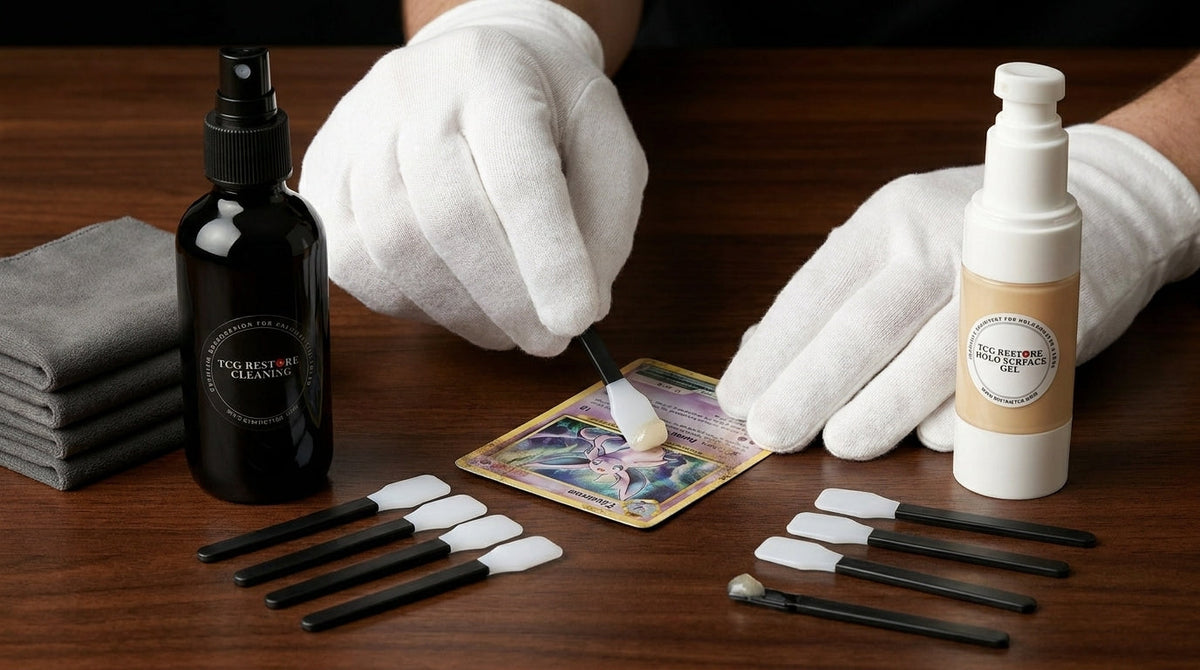
- Clean the surface with a grading-safe cleaning spray and precision cotton swabs for the edges and corners;
- Revive the holographic shine with a shine gel suitable for Holo cards;
- Correct any curvature with a special grading flattening kit;
- Handle with gloves or a premium microfiber cloth, then protect the card in a sleeve + toploader.
Find everything you need in our Pokémon Card Repair & Restoration collection, designed to be 100% safe for PSA, CGC, and PCA grading.
PCA or PSA: which should you choose for your card?
This question comes up a lot, and the right answer depends on the card and what you want to do with it:
- High-value card, international resale (vintage, rare card, English-speaking market): PSA remains the benchmark, its grade resells best abroad.
- Resale in France or Belgium, first grading: PCA is often the simplest, with shipping without customs, service in French and generally shorter turnaround times.
- Modern cards of moderate value, tight budget: CGC offers a good balance between recognition and cost.
In every case, check the prices graded copies of your exact card actually sell for at each company: it is the best indicator.
The population report (PCA, PSA, CGC): what is it for?
Every grading company publishes a population report (« pop report »): for each card, it shows how many copies have been graded, and at which grade. It is a valuable tool for collectors.
- Estimating scarcity: a card with very few copies graded 10 is usually worth more at that grade.
- Deciding whether to submit: if a card very often gets a 10, a 9 will sell for little; if 10s are rare, preparation matters even more.
- Comparing companies: the PCA population report mostly reflects the French-speaking market, PSA's the global market.
The report can be checked for free on each company's website. For details, see our guide PCA population report: how to read it. Keep in mind that it counts copies, not unique cards: the same card resubmitted several times can appear several times.
CGC Pokémon: what you need to know
CGC is known for strict grading and clear labels. Its top grade distinguishes Gem Mint 10 from Pristine 10, reserved for near-perfect cards. Depending on the service chosen, subgrades (centering, corners, edges, surface) may be available: they show exactly where the card lost points.
Submitting from Europe, the Munich office, service tiers: everything is covered in our guide CGC Pokémon: how it works and how to prepare your cards.
Before submitting: estimate the grade
Whatever the grader, examine your card first: our guide pre-grading: estimating your Pokémon card's condition before PSA covers the four criteria. Also check the back edges (see whitening: can it be repaired?) and avoid the 5 mistakes before sending a card for grading.
FAQ
What is the difference between PCA and PSA?
PSA is the most widely recognised grading company in the world and its grade resells best internationally. PCA is based in France: easier shipping from France or Belgium, service in French and often shorter turnaround times, with very good recognition on the French-speaking market.
What is the PCA population report?
It is the public list of how many copies of a card PCA has graded, grade by grade. It helps estimate how scarce a card is at a given grade.
Is CGC recognised for Pokémon cards?
Yes. CGC is one of the three most used companies for Pokémon cards, appreciated for its strict grading and prices that are often more affordable than PSA.
Should you clean your card before grading?
Gently cleaning the surface (dust, fingerprints) is common and avoids losing points on surface, as long as no residue is left. See how to clean a Pokémon card before PSA grading.
To go further
- PCA Pokémon grading: scale, submitting and card prep
- CGC Pokémon: how it works and how to prepare your cards
- Cleaning a Pokémon card before PSA grading: the complete guide
- The 5 mistakes to avoid before sending a card for grading
- Should you clean a card before grading?
Verdict: PSA to maximize the value of high-end cards, CGC for the value for money, PCA for simplicity and speed from Belgium and France. And in any case, a clean and well-prepared card gains points!